

Safety Warnings
NOTE: If you are unsure about some part or procedure in creating or testing a power supply line for a kiln, DO NOT GUESS! If you wire something improperly, you might blow the circuit breaker or burn the place down. Get an electrician or someone who knows.
NOTE: There are many different ratings on the wire and components that make up the supply line that need to be considered (along with proper and safe installation) when creating or testing a kiln power supply. It is beyond the scope of this post to properly educate someone to understand the potential variations and variables involved in this fully. Often, a building like a school or a recreation facility (or even a home) will be inspected for electrical and fire code enforcement. If you do not own the building, or if the kiln is in anything other than a free-standing private workshop for yourself, get permission to do what you want to do from the owner and get an electrician to wire the circuit so you are not liable.
The Data Nameplate
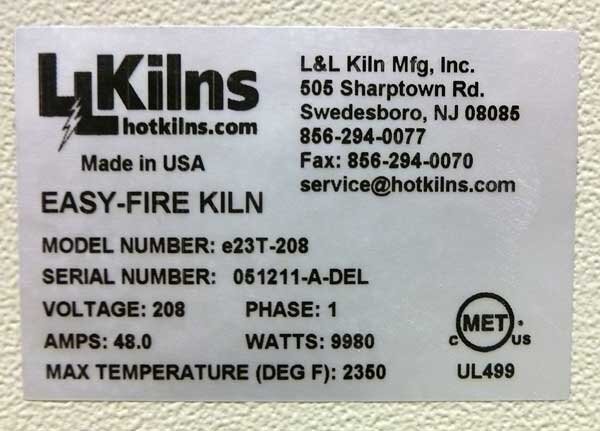
A typical data nameplate: Every kiln has a data nameplate, usually a sticker on the side of the control box, that specifies the model number, serial number, voltage required, phase required, the amperage required, watts produced, and the recommended maximum temperature. This is the information to get from L&L for your particular kiln if you have not received it yet or if it has no data nameplate. The information from the data nameplate is what you show to your electrician or use to procure the proper wire and components to create the power supply line.
Voltage
Most L&L kilns require a specific voltage to operate properly. The Data Nameplate will say in the voltage column either 120, 208, 220, 220/110, 240, 380/220, or 480. Most of the USA is residential- 240 vac, with schools and industry- sometimes having 208 VAC. However, residential can often be 208 (downtown NYC, south-central Idaho, etc.). There are usually no issues with 120 volts. 220 and 380/220 are usually found overseas. 480 is sometimes available for schools or industries. The biggest problem we see is the issue of 208 vs. 240: The kiln that says 208 volts will overheat the elements and burn them out quickly if it is run on 240 volts. Older 208-volt kilns have 208-volt switches also. They will burn out quickly if run on 240 volts. If the kiln is made for 240 volts, it will have about 25% less power and a maximum temperature of about cone 5 (maybe) if run on 208 volts. You should only run a kiln on the voltage that the Data Nameplate specifies if you are to expect the best results. Plus or minus six or seven volts is OK, but keep in mind that the higher the actual voltage is over the recommended voltage, the higher the surface temperature of the element is at any given time. Therefore, it is more likely to burn out early. Likewise, the lower the actual voltage is below the specified voltage, the lower the maximum temperature will be. Voltage is specific to the building and to the time of day. It will probably be lower during the day and higher at night. You can carefully test it with your multimeter to see what it is. It is costly to change the voltage, but this can be done with a transformer. You'll need a good electrician, though. The cheapest way to fix the problem is to replace the elements (and possibly other components) with the proper voltage. The computerized controls will work on either 208 or 240 unless 120, 380/220, or 480 is specified.
Use copper wire
- Always use copper wire with the highest temperature-rated insulation available. 150°C is the rating for the internal wiring up next to the kiln, so a hook-up wire with that rating would be excellent; however, 105°C is adequate. Note: our power cords are rated for 105°C. Keep in mind that for different amperage services, different thicknesses of copper hook-up wire are required. The following chart should give an idea of what is necessary:
- Voltage is not an issue here. Usually, wire like this is rated for at least 300vac, if not 600vac. Look for the wire specifications on the insulation or ask the supplier to be sure. The voltage rating is based on the electrical resistance of the wire insulation (to prevent voltage leaks).
Power Cords
As of January 2001, the National Electric Code Handbook says that a resistive heater this size, on for more than three hours at a time, should be provided a circuit rated for 125% of the total amperage drawn by the unit when it is on high. So, a kiln drawing 43.98 amps would require a service of no less than 54.98 amps. As wire and components for power supply lines are usually rated in increments of 10, the next higher rating is 60 amps.
Note about the 50 amp power cord used on kilns with up to 48 amps: the cord is built to take at least 60 amps (6AWG wire for the hot leads - good per NEC table 310- 16, 8 AWG for the ground, plus oversize copper blades on the plug, and high temperature rating.) This configuration is industry standard. Size the rest of the circuit for 60 amps (i.e., the wires, circuit breaker, etc).
We suggest that 48 amp kilns have a 60 amp breaker and 6 gauge wire (rated for 60 amps). What happens when using a 50 amp breaker, specifically with kilns running so close in amperage to the 50 amp breaker, is usually a series of continuous nuisance trips of the breaker. This is because it is a sizeable resistive load running for long hours at a time, and the kiln manufacturing industry has widely adopted it to use the 125% NEC recommendation to prevent this. If an electrician is unwilling to do this or local codes will not allow it, directly wiring the kiln to a 60 amp breaker (rather than using the cord) is preferred, and the kiln's warranty is unaffected.
The industry name for the supplied power cord on many L&L kilns is Nema 6-50P for all single phase 208, 220, and 240 models drawing less than 50 amps. A few exceptions are the later G models (GD, GT, GQ, and GS) with the 30 amp, four-prong plug. This is a Nema 14-30P plug. The Doll kilns and other 120 vac kilns use Nema 5-15P plugs for up to 15 amps, and Nema 5-20P plugs for 15 to 20 amps. The three-phase Easy-fire kilns use a 15-50P cord. To get the appropriate receptacle, substitute the “P” at the end of the Nema code for an “R.” P for the plug and R for the receptacle.
Voltage Drop over distance
Running power for your kiln over a long distance will result in a voltage drop. The amount is about:
- 7 volts per 100 feet with 10 AWG wire
- 21 volts per 300 feet with 10 AWG wire
- 6 volts per 100 feet with 6 AWG wire
- 18 volts per 300 feet with 6 AWG wire
- 3 volts per 100 feet with 1 AWG wire
- 9 volts per 300 feet with 1 AWG wire
These estimates depend on the kiln operating at 50% to 100% of its capacity, with the temperature of the wire no more than 167°F. Be sure to test the voltage before installing the run so you know what you are working with.
See this link for voltage drop calculators and more information.
Amperage of Fuse or Circuit Breaker
The amperage rating of the fuse or circuit breaker should be 125% higher than the full load amps of the kiln. This is according to the National Electrical Code.
You must then bump this calculated amount up to the next standard-size fuse or circuit breaker.
Examples:
- A kiln has a full load amp rating of 60 amps. 60 x 1.25 = 75 amps. The next closest standard-size breaker is an 80-amp breaker.
- A kiln has a full load amp rating of 48 amps. 48 x 1.25 = 60 amps. A 60 amp breaker is a standard size.
- The fuse amps are typically mentioned in the kiln electrical data located on the wiring diagram.
Always use copper wire to bring power to the kiln; NEVER use aluminum wire. Aluminum oxidizes much more quickly than copper near heat.
Wire sizes are associated with the different size breakers
| 20 amps | 12 gauge copper |
| 30 amps | 10 gauge copper |
| 40 amps | 8 gauge copper |
| 50 amps | 6 gauge copper |
| 60 amps | 6 gauge copper |
| 70 amps | 4 gauge copper |
| 80 amps | 3 gauge copper |
| 90 amps | 2 gauge copper |
| 100 amps | 1 gauge copper |
| 125 amps | 1/0 gauge copper (pronounced "one aught") |
| 150 amps | 2/0 gauge copper (pronounced "two aught") |
| 175 amps | 4/0 gauge copper (pronounced "three aught") |
| 200 amps | 250 MCM copper wire (MCM = Thousand Circular Mils) |
| 225 amps | 350 MCM copper wire |